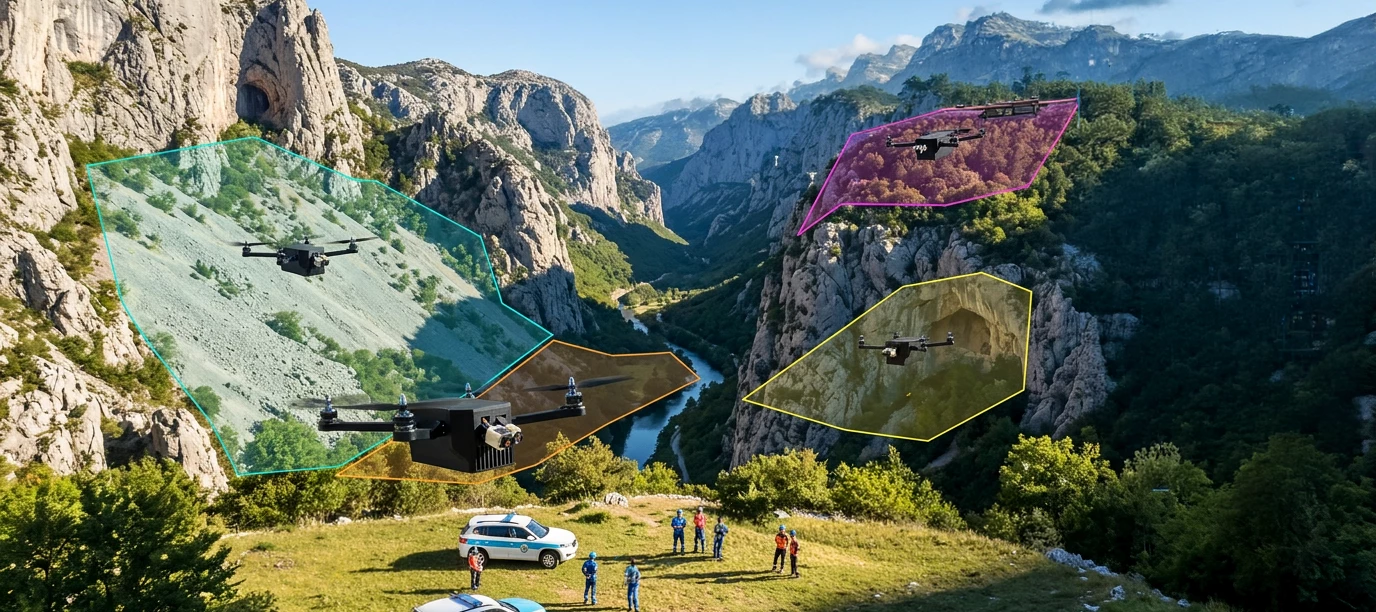


Croatia's Adriatic coast is one of Europe's most celebrated destinations. Millions visit every year for the water, the islands, and the historic coastal towns. Many of those visitors are adventurous by nature, and the dramatic limestone mountains rising inland pull them off the beaten path. The terrain is beautiful and unforgiving in equal measure. When hikers go missing, mountain rescue teams cover enormous ground on foot, working against terrain and time.
Founded in 2025 by drone-technology veterans across Croatia, Slovenia, and Spain, DroneStar AI is built around a single conviction: one operator should be able to run a whole pack. Multiple drones, one person, full autonomy on board each aircraft. The result: a safety response that scales as fast as the situation demands.
Born from the Mountains of Croatia
Mountain search and rescue means terrain that defeats ground teams fast: steep ridges, dense forest, unstable ground. Drones cover in minutes what takes a team hours on foot. But the traditional model had a hard constraint: every drone needed its own operator, and because regulations demand constant watch on the aircraft, a second person was often needed just to scan the video feed for any sign of a missing person. More terrain meant more people and more time, precisely the resources in shortest supply when someone is lost and conditions are changing fast.
Their answer was to move the intelligence onboard. If a drone could plan its own path, run its own detections, and make moment-to-moment decisions on its own, but within set constraints, a single operator could supervise an entire pack. More coverage, faster response, and a search capability that could scale to the size of the problem rather than the size of the crew. In practice that shifts the math from one operator per drone to one operator for five to ten of them, which means a significant reduction in the cost of running a mission.
The Technical Challenge: Intelligence in the Air
The challenge is physical. A drone carrying full autonomy onboard must do it within strict weight and power limits, running path planning, object detection, and target tracking simultaneously, in real time, on a platform that has to stay in the air.
"The way we achieve this is to pack as much autonomy onboard the drone as possible," explains Vasja Urbancic, DroneStar's AI lead. "That includes determining the path to travel, running detections, and running the tracking with complete autonomy from the ground control."
“The whole system is designed around one idea: the drone should never need to ask what to do next. It plans the route, runs the detections, tracks what it finds. The drone handles the search; the operator focuses on the rescue,” explains Hrvoje Pavicic, DroneStar’s COO.
The Architecture: Axelera at Every Layer
To make this work, DroneStar needed AI hardware powerful enough to run all of this inside a drone, yet compact and light enough to leave room for batteries and range.
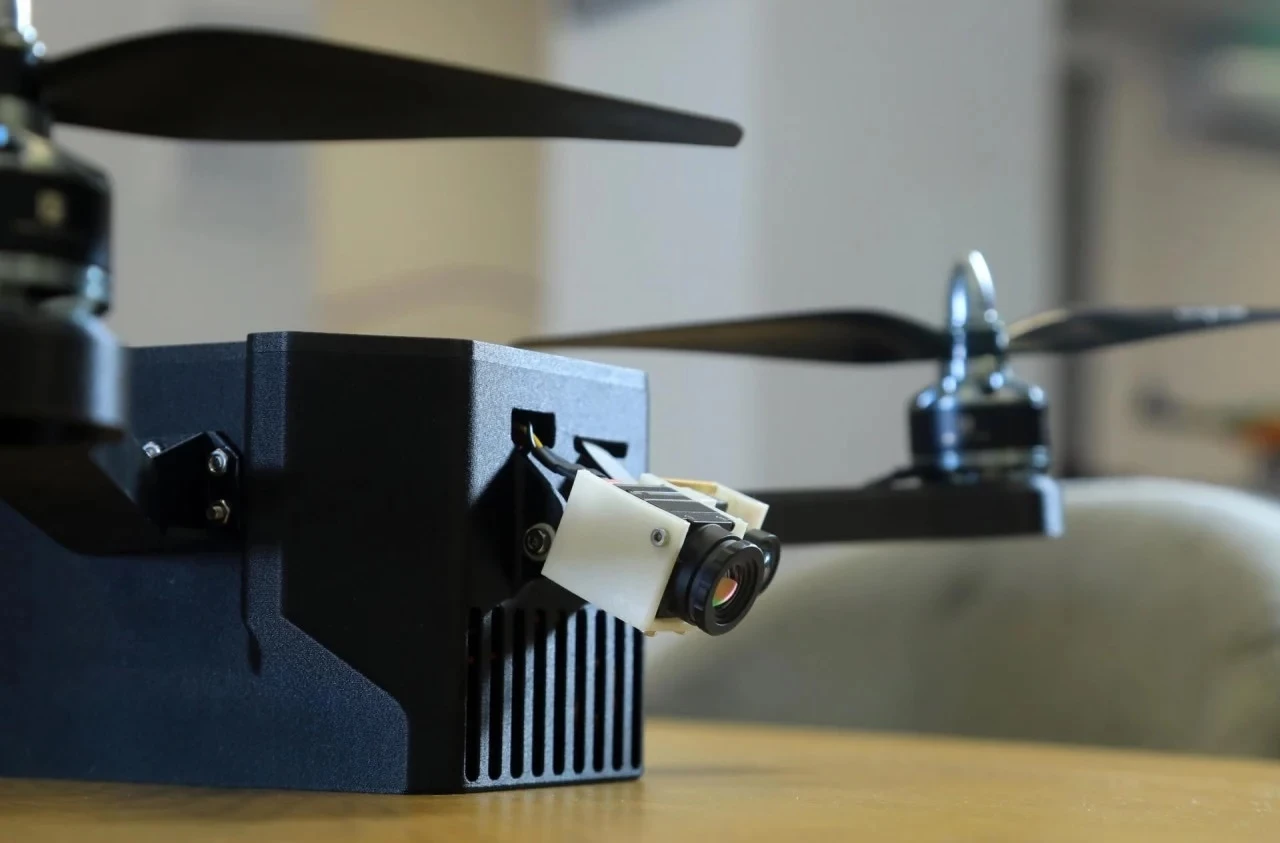
They chose Axelera’s Metis® AIPU.
Each DroneStar drone carries an Axelera Metis M.2 module, handling real-time inference in flight: object detection feeding a tracking pipeline capable of identifying persons or vehicles across both optical and thermal cameras. Thermal imaging means the system works at night, which is critical when a search extends past dark and every minute counts. In flight, the module runs that detection-and-tracking pipeline on 1280×1080 video at the camera's full 20 FPS in real time, with headroom to spare. The system has enough capacity to parallelize additional input streams, run cascaded models, or layer in more complex pipelines.
Back on the ground, the dock housing the pack runs an Axelera Metis® single-board computer (SBC), sequencing takeoff and landing to prevent collisions, consolidating telemetry and detections, and feeding it all up to PackMind, the onboard coordination layer.
DroneStar's software platform: the operator can open on a phone, tablet, or PC to command the pack from anywhere, and the layer that controls the dock. For government and emergency-services customers with strict data requirements, it runs on a private cloud instance, keeping all telemetry and detection data in the customer's own environment.
Even so, some decisions stay in human hands. The operator draws the boundaries of the search area, and once the drones have computed their search paths, confirms the plan and launches the mission. From there, the rest of the mission is pack-autonomous, though at any point the operator can command a single drone or the whole pack to hover, land, or return home.
The dock adds another layer of intelligence the drone can't afford in the air. Onboard, every computation must happen instantly, the drone making live flight decisions and avoiding obstacles even as it runs detections. The dock has no such constraint, and DroneStar is building toward using that headroom to double-check uncertain detections, sharpen unclear images, and filter out false positives before they become noise.
Why Axelera
DroneStar evaluated a variety of top edge AI accelerators before committing. Two factors decided their selection.
The first was performance. "All the benchmarks, it came out on top, so it was a very easy choice," says Vasja. The compact M.2 form factor sealed it: it delivered that performance in a package small, light, and efficient enough to fly while being power efficient.
The second was supply chain transparency. As DroneStar expands into security and critical infrastructure markets, customers and regulators want to know exactly where the hardware comes from. The ability to point to a fully auditable, traceable hardware stack matters commercially and in terms of compliance.
For software integration, the team uses the Voyager® SDK to bring their AI models to the Axelera hardware. Getting going was fast: from first contact with Voyager to their first successful inference on the M.2 took a matter of hours. As detection capabilities evolve, they update and redeploy models through the SDK without rebuilding the underlying system.
What DroneStar Is Building
DroneStar also deploys the pack for perimeter security. A single dock can house up to four drones, with one operator managing the full pack through a web dashboard. Virtual fences define no-cross zones; the drones patrol pre-planned routes, detect and track anything that enters, and push detections to the operator's screen automatically.
The first commercial proof of concept, a 2 km × 2 km solar farm in southern Spain, is scheduled within the next month.
A second pipeline is in late-stage development with a telecommunications company. Static cameras on its towers scan for smoke; when one detects it, the tower's system issues an alert and activates a dock-mounted drone that dispatches on its own. No operator is in the loop. It confirms the fire, GPS-tags the exact location, and feeds that coordinate directly to emergency services before returning to the dock. "The fire department can access it much faster than usual," says Hrvoje.
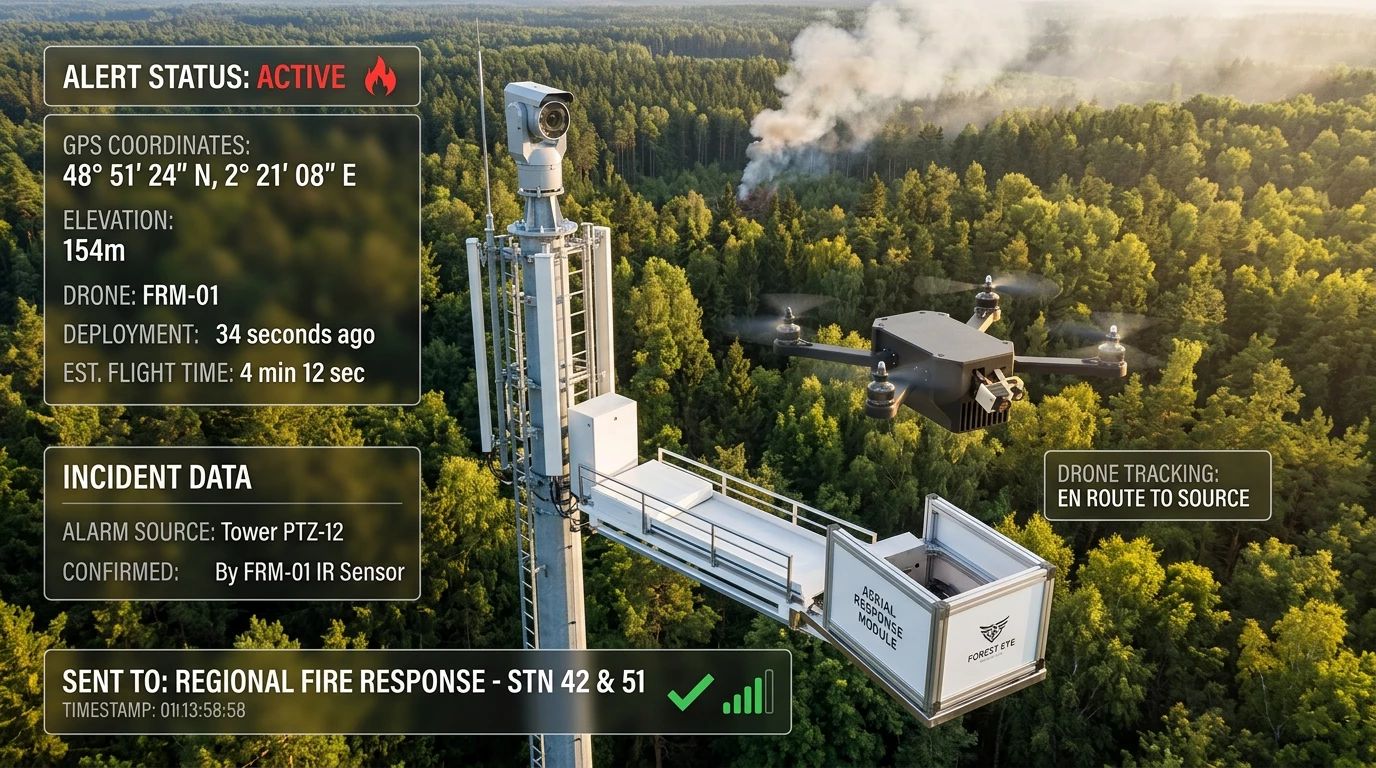
“The fire scenario is the one I find most compelling, because there is no operator involved at all,” continues Hrvoje. “The camera sees smoke. The drone goes. It confirms the fire, marks the location, and the fire department has a GPS coordinate within minutes. That’s a system that acts on its own when every minute matters.”
Search and rescue, the original founding mission, is on the near-term roadmap. It's technically harder than perimeter patrol because there's no pre-planned route, and the search area is dynamic. That's where the division of labor comes into focus: PackMind partitions that area and assigns each section to a drone in the pack. From there, each drone plans its own route, flies it under autopilot, and runs its own detection and tracking, while PackMind consolidates what every drone finds and coordinates with the ground station.
DroneStar already has a pickup truck kitted out as a mobile drone base for mountain rescue teams, the dock drawing power from the vehicle's battery in the field.
Europe's Autonomous Drone Company
The market is wide open: solar and wind-farm security, wildfire detection, coastal and border monitoring, mountain rescue, critical-infrastructure protection. The platform is application-agnostic: swap the detection models, and the same hardware and software stack applies to agriculture, logistics, or anywhere else a drone has value.
DroneStar is even exploring a future "smart box": a modular AI-and-autopilot unit it could license to other autonomous-vehicle makers, boats, and ground vehicles, extending the Axelera-powered stack well beyond drones.
For Axelera, DroneStar represents exactly the kind of customer we built for: a team of engineers doing genuinely hard work in a demanding environment, where performance, power efficiency, and supply chain integrity all matter. We're proud to power their pack, and looking forward to watching it grow.
DroneStar AI is based in Split, Croatia, with team members in Slovenia and Spain. Learn more at dronestar.ai.
Interested in building on Axelera? Explore the Voyager SDK and partner program.