










Discussions on emerging technologies, trends, breakthroughs, and AI news
Recently active
Hi, I’m from India. Currently exploring AI and digital systems.Interested in learning AI automation, agent building, and real-world business use cases.Looking to connect and collaborate.
The AI industry has spent the last few years in a language arms race. Bigger LLMs, faster token generation, more natural conversation. The implicit assumption is that the pinnacle of human-machine interaction (HMI) is getting a computer to understand and respond to our words. But the more projects I see here on the Axelera AI community, the less essential that object seems to be.I’ve become a bit fascinated not just by HMI systems, but HAII (human-AI interaction, if there is such a designation), and here's a number worth sitting with that I found on my travels.Human speech transmits roughly 39 bits of information per second. That's consistent across every language ever studied. Meanwhile, visual processing handles around 10 million bits per second. We've spent billions of dollars optimising AI for our slowest, most ambiguous communication channel, and largely ignored the one that's 250,000 times faster.The race to shrink a 100-billion-parameter language model onto an edge device makes
Red Dwarf’s really well known for how well it predicted (albeit comedicaly) VR tech, but it did a lot more than that. It heralded a lot of advance in AI that we’re now actually seeing emerge: conversational appliances, narcissistic holograms, forgetful mainframes, and borderline neurotic robot butlers not being the least of them.25th November = Gazpacho Soup Day. Look it up.The show was set in the 22nd Century, but it’s only 2025 and it’s already coming true. With edge AI powering robotics, smart devices, and real-time vision on the edge, so many of those hilarious sci-fi predictions are fast becoming reality. From Rimmer's hologram (an early take on digital consciousness) to Kryten's helpful, protocol-bound persona (think domestic service robotics with a strong opinion on laundry), Red Dwarf imagined AI not just as powerful, but as delightfully flawed. That might actually be the brilliance of what it predicted over some of its more popularised contemporaries like Star Trek or even The
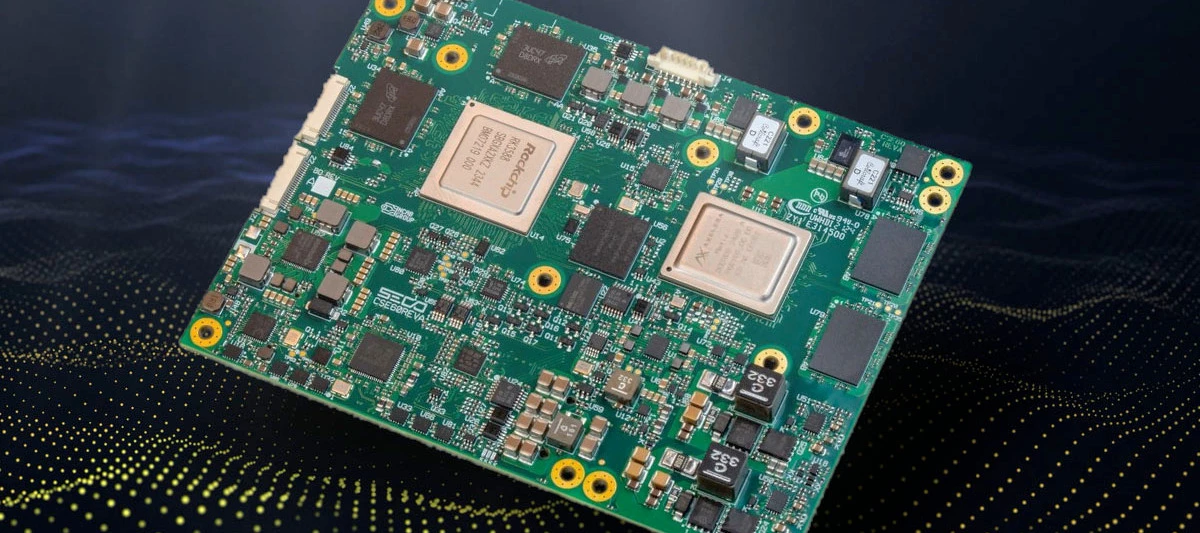
Great piece from SECO that showcases what’s possible when you combine the Metis AIPU with their SOM-COMe-BT6-RK3588 module. It’s a solid breakdown of how edge-native AI hardware is reshaping vehicle inspection, both in manufacturing and post-sales scenarios like insurance claims.The setup: Rockchip RK3588 (4x Cortex-A76 + 4x Cortex-A55) Metis AIPU delivering up to 214 TOPS Up to 8 HD video feeds processed in parallel Real-time object detection + OCR <50ms latency per stream, at the edge No cloud. No data back and forth. Just low-latency, high-throughput inferencing where the data is created.They also go into the pipeline architecture: camera -> local memory -> CPU/VPU pre-processing -> AIPU for inference -> post-process -> system output; and how this gets mapped to Metis efficiently.And they’re running YOLOv8S on 8x 1080p60 streams with room to spare, which is not unimpressive!It’s a solid reference if you’re thinking about multi-camera setups, inspection task
TechCrunch piece about a nonprofit that had GPT and Claude models run a fundraising op on their own—no human help except setup. The AIs picked a charity (Helen Keller Intl), made docs, set up socials, emailed people, and ended up raising $257 in a week!Can’t tell if this is good or bad...https://techcrunch.com/2025/04/08/a-nonprofit-is-using-ai-agents-to-raise-money-for-charity/
About 40m of 2020 aluminium profile just arrived for the CNC machine I’m building! I suddenly feel like this might be a bigger job than I initially planned…Anyway, that’s for another day. What’s crossed my mind now is whether anyone’s seen any projects that combine CNC with vision AI? I’m thinking it’d be cool if I could combine the two, since I’m building one machine anyway.Predictive maintenance, maybe? Although this is a homemade machine, so that’s not a huge issue.Perhaps positioning and alignment could be something AI could get involved with? That could potentially be useful and reduce waste. Any other ideas of existing projects anyone’s seen in this area?
Check out our own @jonask-ai showing real-time, high-precision 8K object detection demo at Embedded World. An Aetina box, four Metis cards, and a whole lot of tile-based inference.What’s cool is it runs YOLOv8l across 380 overlapping tiles per second—no downscaling—at just 57% compute. And it’s not a one-off: same setup anyone can build with Voyager SDK + a YAML file.Noice!You can find out a bit more about this in @Doug’s blog post, too.
Gugging face just snapped up a humanoid robotics startup (Pollen Robotics, the folks behind Reachy 2). Open source robots are officially happening. Imagine a robot that serves coffee and critiques your model training while it’s doing it. I’d buy that!In all seriousness, it does actually feel like a big moment for open robotics.https://techcrunch.com/2025/04/14/hugging-face-buys-a-humanoid-robotics-startup/
Just read a piece about Databricks working on this idea called TAO (Test-time Adaptive Optimization). Supposedly helps models improve themselves without clean labelled data — sort of like RL with synthetic practice rounds?Sounds clever, but also feels like one of those things that might work great in theory and fall apart in the wild. Anyone come across it in more detail or seen use cases outside research circles?
Already have an account? Login
No account yet? Create an account
Enter your E-mail address. We'll send you an e-mail with instructions to reset your password.