

Mini PCs Are Running Millions of AI Inferences a Day. AI Vision Is Next.
Tom's Hardware recently profiled a developer running millions of tokens a day on two mini PCs, ditching cloud APIs entirely to cut costs. It's just one example of a broader shift as AI becomes more capable and more embedded in daily operations. The case for running it locally, on hardware you own, grows stronger. Open-weight models have matured, purpose-built AI accelerators have arrived, and the mini PC has evolved from a compact curiosity into a serious computing platform capable of replacing traditional desktops across a wide range of workloads.
For AI vision, that shift is particularly significant. A factory line running continuous defect inspection generates too much data to route to the cloud efficiently. In fact, according to Market Mind Partners, “over 40% of manufacturing plants globally are projected to use edge-enabled computer vision systems by 2027.”
A security control room monitoring dozens of feeds needs local processing to stay responsive. A retail deployment tracking foot traffic and dwell time shouldn't be sending sensitive video off-premises. Bringing AI vision in-house means processing data where it's generated, scaling deployments for actual operational needs rather than cloud architecture constraints, and building systems that remain fully functional regardless of network conditions or API pricing changes.
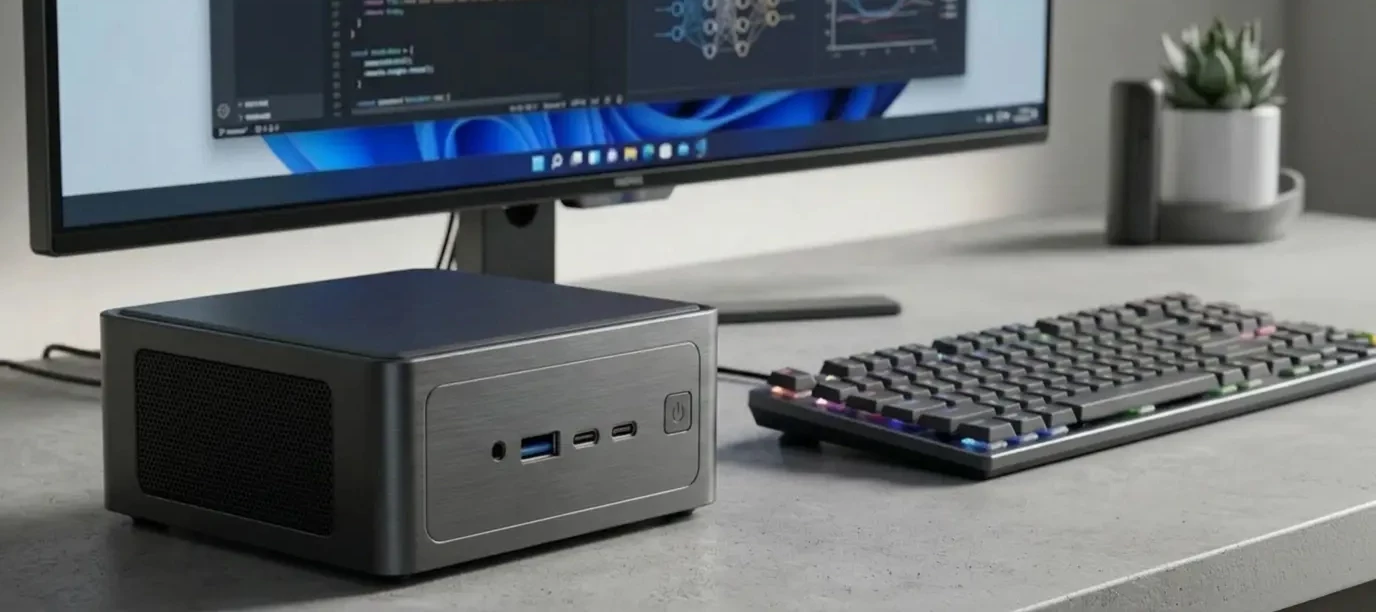
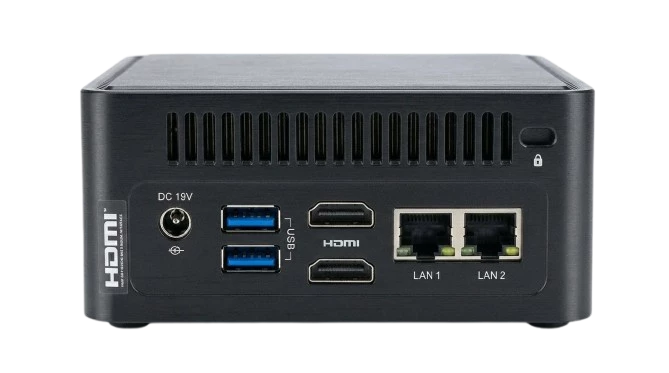
That's the opportunity we’re addressing with the launch of the Mini PC. Powered by the Axelera Metis® M.2 Max accelerator, it takes the compute performance of Axelera's PCIe card and puts it into a compact, edge-ready device designed for the environments where AI vision is actually deployed.
Documentation is comprehensive, support is direct, and from the moment the device arrives, it’s ready to run.
Real Deployments. Real Environments. Real Results.
Smart City Infrastructure
For a smart city deployment, one compact device can cover an entire intersection cluster. Monitoring traffic flow, detecting stopped vehicles, identifying pedestrian conflicts, and flagging incidents to a central operations centre in real time. All processed locally, without a network dependency, and without the infrastructure overhead of GPU-based systems.
Industrial Quality Inspection
Manufacturing environments are unforgiving. Equipment runs continuously, tolerances are tight, and the cost of a missed defect can be measured in product recalls, warranty claims, and reputational damage.
Unlike standard GPU-based systems, the Axelera AI Mini PC is built for the factory floor, deployable directly next to the production line, without requiring dedicated air-conditioned enclosures. Multiple camera feeds run simultaneously, inspecting surface defects, verifying assembly, and checking label placement all in real time, on a single device.
Retail Computer Vision
Understanding how customers move through a physical space is one of the most valuable and underutilised datasets in retail. Foot traffic patterns, dwell time at displays, queue length at checkouts. All of it informs layout decisions, staffing models, and promotional placement.
With the Axelera AI Mini PC running on-device inference, retailers can deploy computer vision analytics without routing sensitive video data to the cloud. Processing happens locally. Privacy is preserved by design. And the operational overhead of managing cloud inference costs disappears entirely.
Security and Surveillance
Whether it’s perimeter monitoring at a critical infrastructure site, licence plate recognition at a logistics hub, or object tracking across a large outdoor area, surveillance applications demand consistent performance under variable conditions.
The Axelera AI Mini PC handles long-duration inference workloads without throttling, operating reliably across the temperature ranges and duty cycles that continual surveillance demands. Teams can move from hardware procurement to a deployed system faster than any GPU-based alternative.
What Changes with the Axelera AI Mini PC
The Axelera Metis M.2 Max accelerator brings the performance of Axelera's Metis PCIe card into an M.2 form factor, purpose-built for the kind of continuous, edge-deployed inference that factory floors, security operations centers, and smart city infrastructure needs.
It runs on an Intel® Core™ Ultra CPU, which handles pre and post-processing, display rendering, and system management, removing the need for a dedicated GPU entirely. That alone significantly reduces upfront hardware costs and power consumption compared to traditional GPU-based edge deployments. It ships with DDR5 RAM and onboard storage.
Under the Hood: The Numbers That Matter
Performance
Numbers that defines what the Axelera AI Mini PC can do.
15 TOPS/W: Energy efficiency that delivers server-class AI inference at just 3.5–11W typical power draw. For every watt consumed, the Metis M.2 Max accelerator delivers more AI compute than any comparable edge device in its class. That efficiency translates directly into lower operating costs, simpler cooling requirements, and longer hardware lifespans in the field.
Up to 3× faster than competing solutions proven not only by Axelera AI internal testing, but confirmed and verified by third-party testing.
25+ simultaneous streams at 1080p/20FPS on a single device. For multi-camera deployments such as traffic intersections, factory floors, or retail spaces, this means fewer nodes, lower infrastructure costs, and simpler system architecture.
For the full performance breakdown, benchmark methodology, and comparison data, see the Metis M.2 MAX accelerator page.
Technical Specifications
| Specification | Value |
|---|---|
| AI Accelerator | Metis® M.2 MAX, 8GB RAM, active cooling |
| Processor | Intel® Core™ Ultra 125H (Meteor Lake-H) |
| Memory | 32GB DDR5, up to 5600 MT/s |
| Storage | 256GB NVMe SSD |
| Operating Temperature | 0 to 40°C |
The absence of a dedicated GPU is not a limitation. It’s the design intent. By integrating the Metis M.2 Max accelerator directly alongside an Intel Core Ultra CPU, Axelera AI has removed the most expensive, most power-hungry, and most thermally demanding component from the edge AI stack entirely.
Read the full technical specifications
Software: The Voyager® SDK and Model Zoo
Hardware is only half the equation. The Voyager SDK provides a complete end-to-end toolchain for deploying AI models on Metis-powered hardware from model optimization and quantization through to runtime deployment and performance monitoring.
The model zoo includes over 100 pre-trained models covering the most common computer vision tasks:
-
Object detection
-
Image classification
-
Semantic and instance segmentation
-
Pose estimation
-
Face detection and recognition
-
Licence plate recognition
For teams bringing custom models, the Voyager SDK handles the conversion pipeline with minimal friction, and benchmark results are published for all supported models so teams can evaluate performance before committing to a deployment architecture.
Our getting started guide walks you through installation, user guides, tutorials, and all step-by-step concepts at the Axelera AI documentation portal.
Order Today. Deploy This Week.
The Axelera AI Mini PC is available right now on Axelera AI store. Documentation is comprehensive, support is direct, and from the moment the device arrives, it’s ready to run.
Explore the Voyager SDK documentation.
Got any comments or questions? This is the place to ask them, so post below and we’ll get right back to you.
Axelera AI® is redefining what is possible at the edge. The Metis® M.2 MAX accelerator and Voyager® SDK are registered trademarks of Axelera AI B.V.