

BN-Twin: Deterministic Digital Twin & High-Precision Control powered by Voyager Wingman

  • August 1, 2026
  • 2 replies
  • 78 views

Ben_Alba
Cadet
Forum|alt.badge.img

Hey Axelera team and community! 👋

I saw the Prompt Challenge ad on my phone screen back on July 23, 2026, and it got me really excited enough to dig back into an old, paused concept I'd been sitting on BN-Twin and finally turn it into a working software demo.

Now, I want to take this working engine and supercharge it on real Axelera hardware using Voyager Wingman!

💡 What BN-Twin Does

BN-Twin is a single deterministic engine designed for two Industry 5.0 needs:

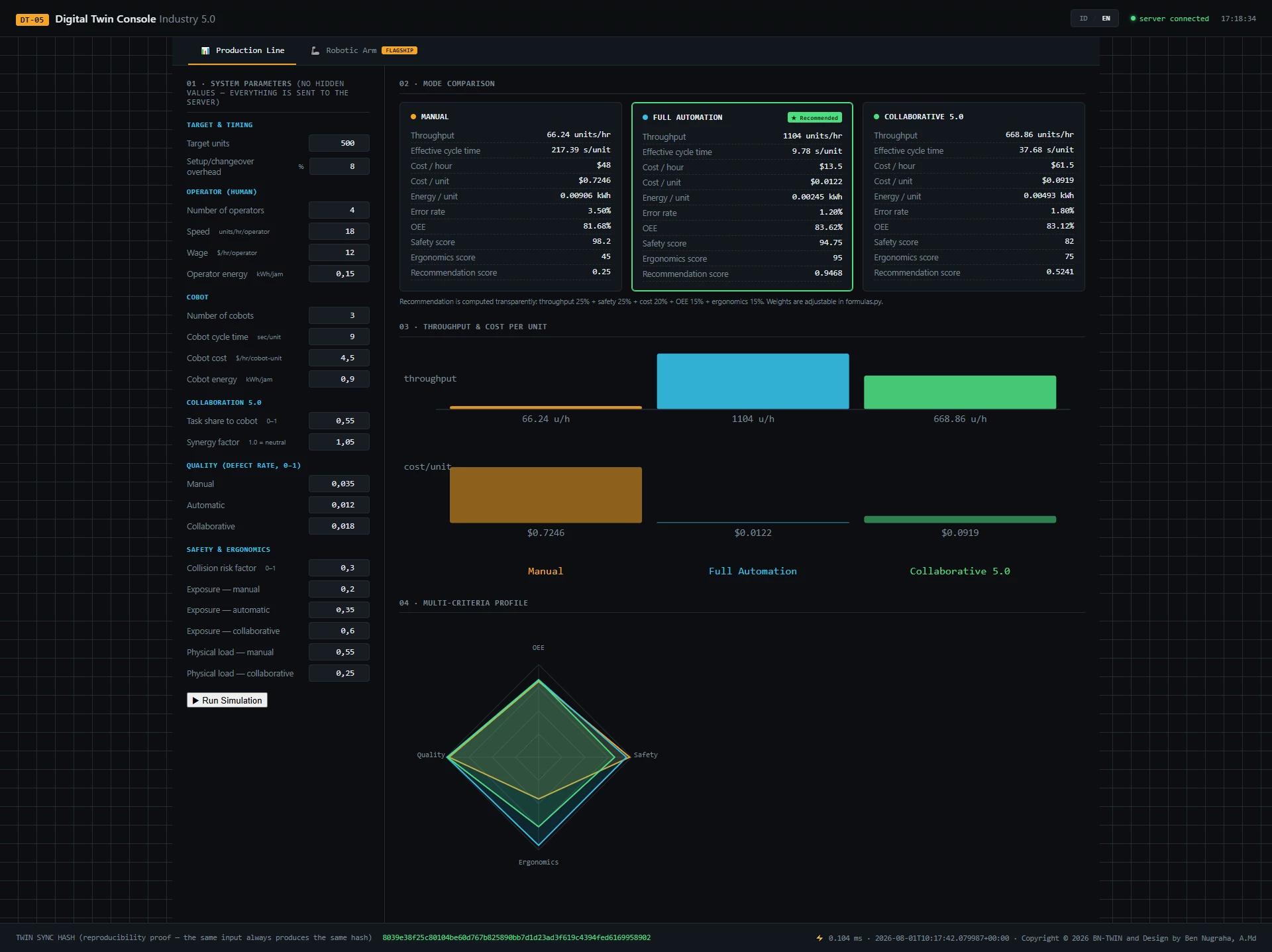
  1. Trustworthy Cobot Investment Decisions: Running transparent, non-black-box simulations comparing manual, automatic, and collaborative production lines.

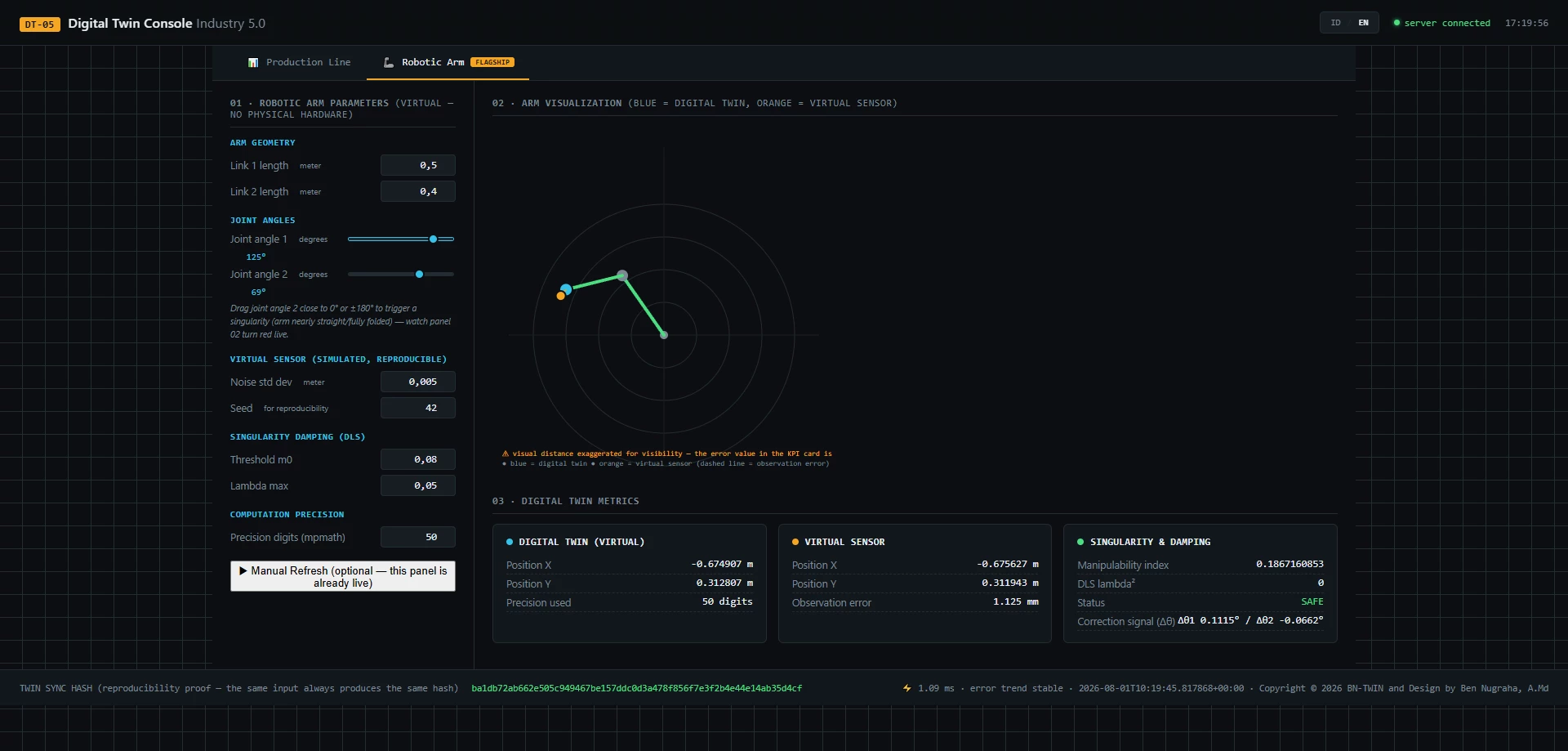
  2. High-Precision Robotic Control: Controlling robotic arms with 50-digit precision kinematics while while damping motion instabilities at singularities instead of letting control corrections spike.Instead of just logging errors, it calculates the real-time joint-angle correction needed to close the loop, the actual control math, ready to be wired to real actuators once hardware integration begins.

🖼️ Current Working UI & Features (Screenshots attached)

  • Robotic Arm Console: Live kinematics visualization, 50-digit precision (mpmath), singularity damping status (SAFE), and live joint correction signals ($\Delta\theta$).

  • Production Line Dashboard: Multi-criteria decision engine comparing Manual vs. Full Auto vs. Collaborative 5.0 (analyzing throughput, OEE, cost per unit, and ergonomics).

  • Cryptographic Proof: Every run generates a green TWIN SYNC HASH at the bottom to guarantee 100% reproducible results, paired with Fernet+PBKDF2 encryption for IP security.

🛠️ The Mission with Voyager Wingman & Metis

Since the core software logic is already running, my goal during the build month is to port and accelerate it on Axelera silicon:

  • Metis Pipeline Setup: I will use Voyager Wingman prompts to automatically generate, wire, and optimize the Metis execution pipeline on the Dell XE5 setup without writing complex YAML configurations manually.

  • Upgrading to Live Vision: Right now, the arm module uses simulated virtual sensors. I plan to prompt Wingman to help integrate a real-time computer vision pipeline via the Voyager SDK, replacing virtual sensors with camera feedback to track actual physical end-effector positions.

🚀 Why This Proposal?

Having a working software baseline means zero time wasted starting from scratch. I can jump straight into testing Voyager Wingman, generating pipelines, and benchmarking performance on real Axelera hardware from day one.

Excited to see how fast Wingman can take this project to the next level. Let me know what you think! 🚀 
below link github :

https://github.com/BenNugraha/DT-BN_TWIN_Tech


2 replies

Spanner
Axelera Team
Forum|alt.badge.img+3
  • Axelera Team
  • August 11, 2026

First of all, that you saw the ad on your phone and it dragged a paused project back out of the drawer has quietly made my week! 😄 I have a lot of such projects, and it always feels wasteful when they go unfinished, so great job on that alone!

On the actual idea, the transparency angle is really intriguing. I’d assumed that somebody has to sign off a very large spend on a cobot line, and they're likely handed a number by a simulation nobody can actually interrogate. So the answer arrives with no way to argue with it, which means the decision gets made on trust or on vibes.

Being able to see why the simulation says what it says changes that conversation entirely. It's the difference between a tool that tells you the answer and one that lets you disagree with it. And letting a camera close the loop on what the arm is really doing, rather than what it was told to do, is a proper next step. Great work!


Ben_Alba
Cadet
Forum|alt.badge.img
  • Author
  • Cadet
  • August 11, 2026

Yup, I'll admit it. this Axelera challenge is what got me fired up. Five years ago, without AI models like we have now, a project needing this much sustained focus wouldn't have been easy to finish.

Really appreciate the input, and you put it better than I did: "the difference between a tool that gives you the answer and a tool that lets you disagree with it." That's exactly the gap I was trying to close.

You're right about the trust problem too. A lot of investment simulations basically ask people to take the number on faith, with no way to trace the reasoning behind it. With a verifiable hash on every run, plus formulas you can actually inspect (once decrypted), that "just trust the output" dynamic turns into something you can actually question.

I also wasn't starting from zero, the deterministic core and the math were already solid, so the effort goes straight into hardware integration.

And then closing the loop with the camera is the next big step. Right now the arm module just executes commands without questioning them; being able to verify what's actually happening is the whole point of calling it a "twin" instead of a script. Can't wait to get it running on Metis.