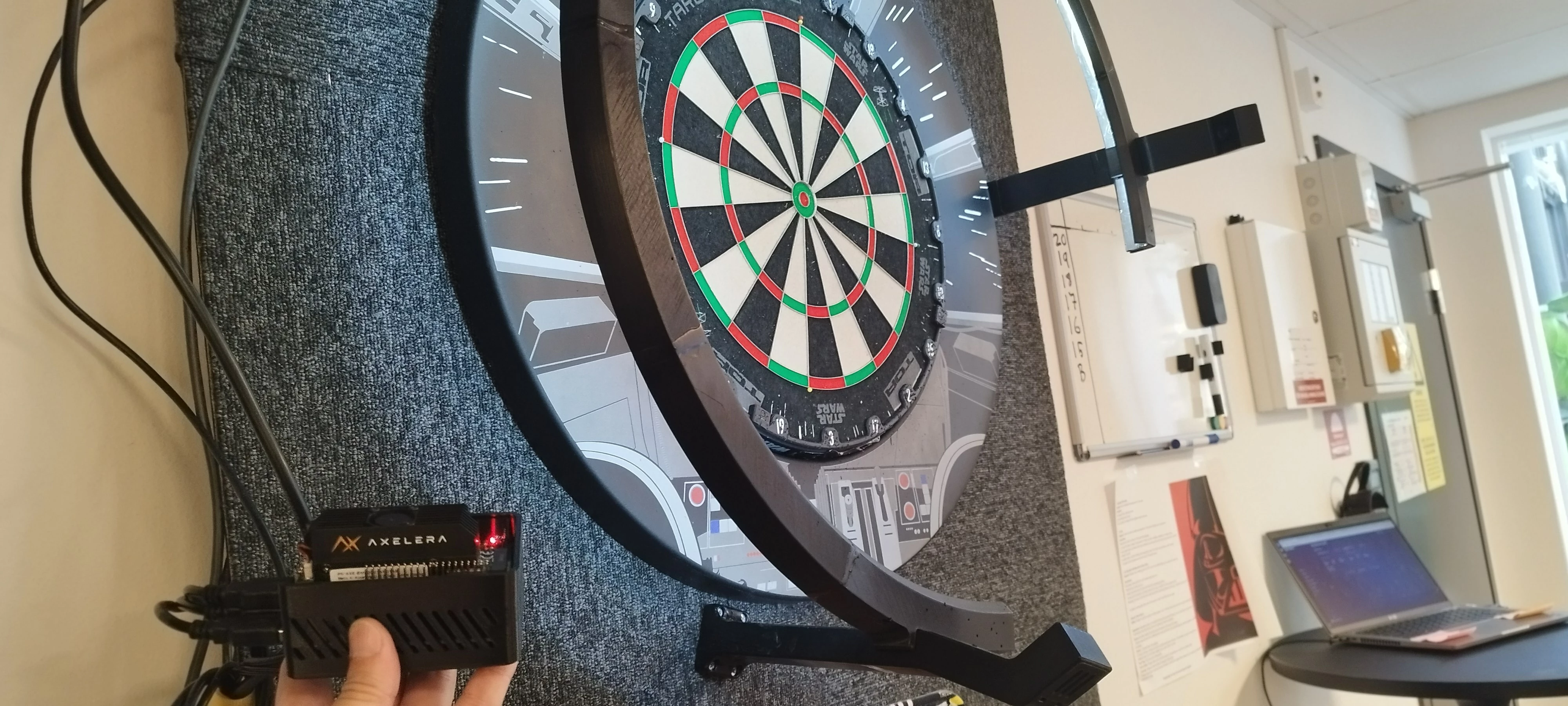
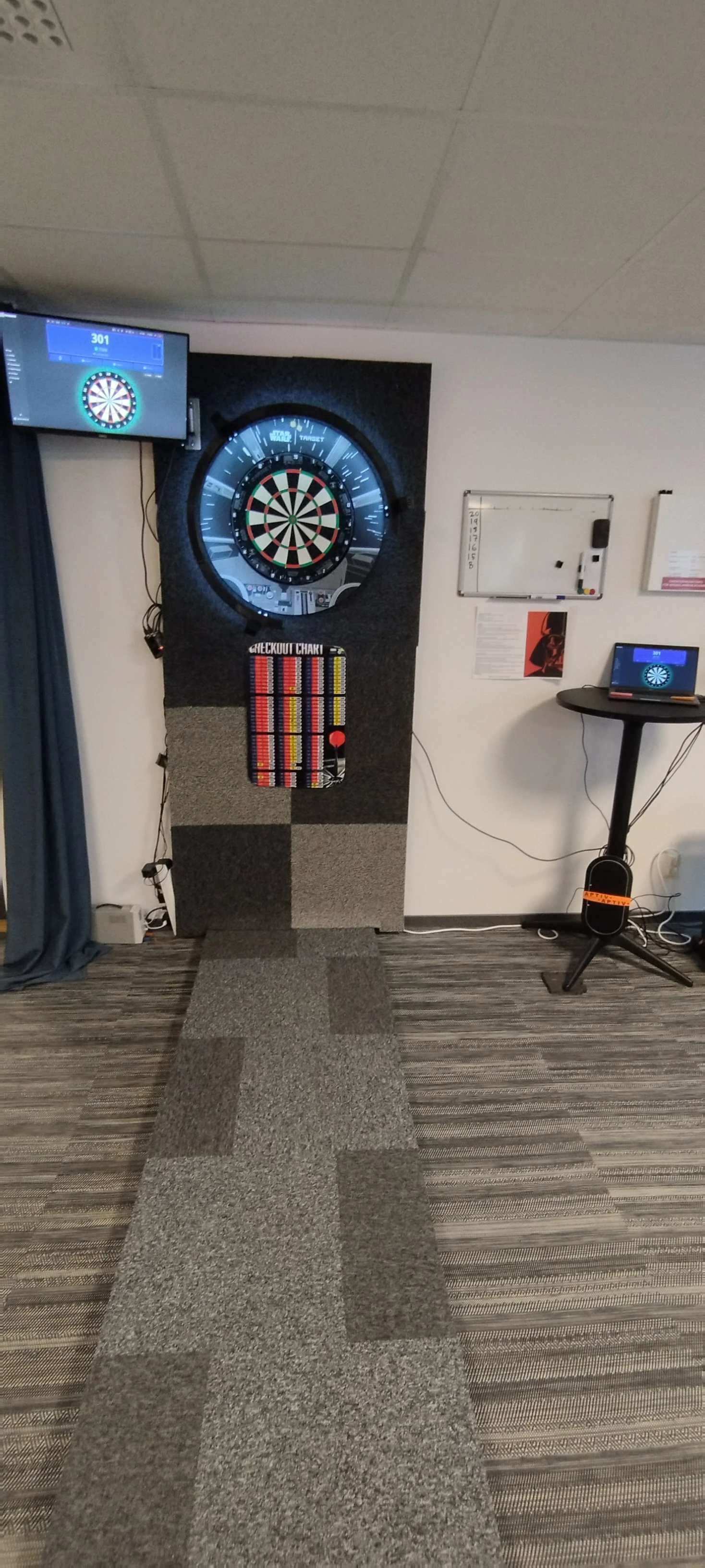
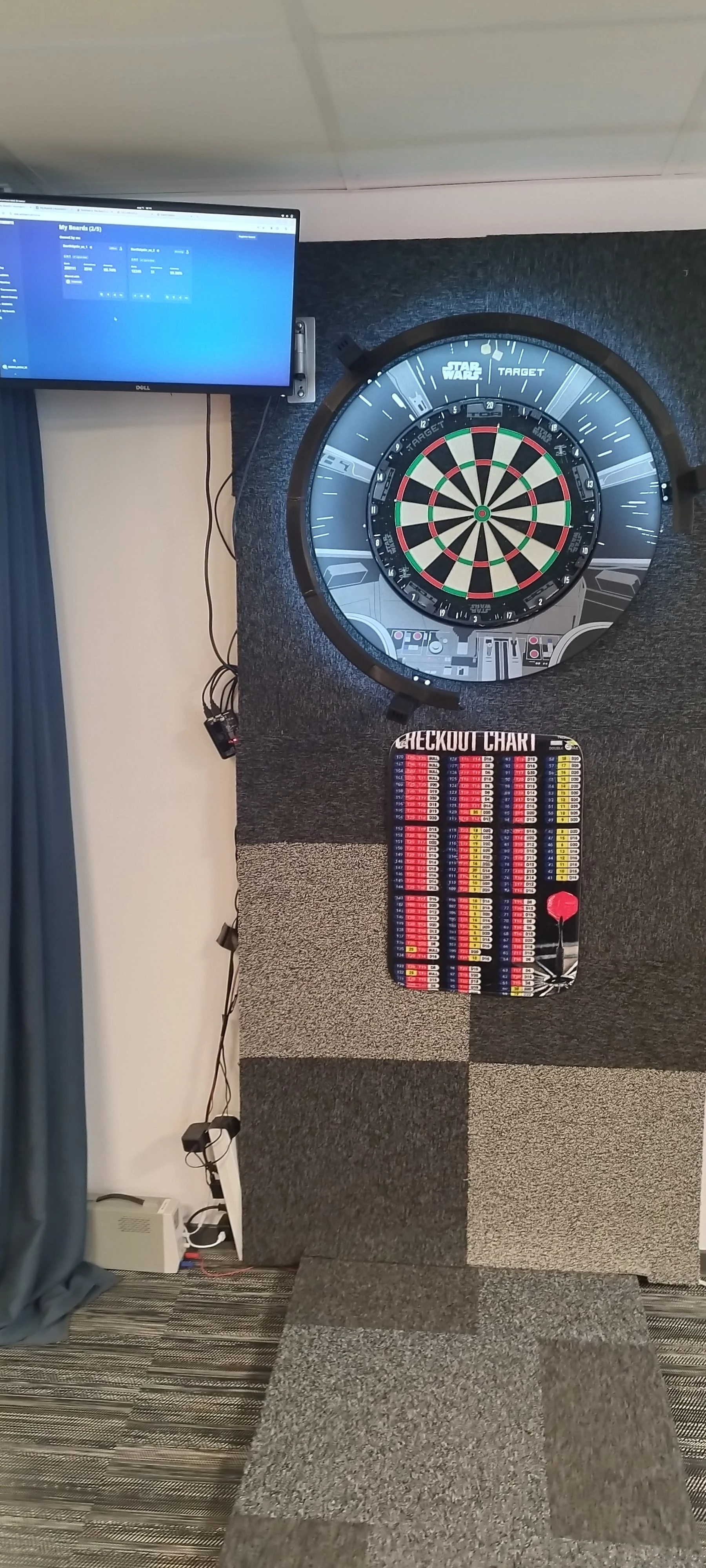
DartWingman turns a standard dartboard into an affordable, fully offline AI referee and personal practice coach. Deployed using the low-cost Axelera Metis NVMe device in a compact Mini PC or Raspberry Pi–class system.
Three board cameras provide camera data of the board for automatic scoring; one or two player-facing cameras add throw-consistency analysis.
System selftrains and builds a visual LLM for dartboard, dart angles and takeouts, to improve dart scoring, and player stance & throw. And gives feedback to player.
Goal is to have an AI supported darts trainer with advanced multi-camera AI usable without cloud inference or an expensive gaming PC.
------------------
Initial first prompt.
Build the first real-time Metis pipeline for DartWingman, an affordable AI darts referee designed to run on a compact host computer (Nuc/Raspberry Pi 5 or similar) with an Axelera Metis M.2/NVMe device. Additionally build a pose detection system, that tracks a players throws and pose using 1-2 cameras facing the player, this should give feedback to player on their movement and throws.
Use three fixed cameras aimed at one standard dartboard:
- Cameras are placed around the board about 25-40 cm away from wall attached to a led light ring at 120 degree apart pointing inward to the bullseye.
Phase 1 goal: reliably detect, calibrate and track the dartboard, then detect when a dart has newly entered the board. save images for local Visual LLM model build that supports accuracy of scoring.
Requirements:
1. Detect the dartboard in each camera stream.
2. Identify the board centre, outer scoring boundary, double ring, treble ring, outer bull and inner bull.
3. Create a persistent calibration transform for each camera that maps image coordinates to a common dartboard coordinate system.
4. Allow a user to confirm or correct calibration through a simple local calibration UI, then save the calibration configuration.
5. Compare consecutive frames and detect a newly appearing dart in the board area.
6. For each new dart event, return:
- timestamp
- camera ID
- detection confidence
- dart tip coordinate in the common board coordinate system
- estimated dart angle where possible
- cropped image of the detected dart
- keyframes from all three cameras around the event
7. Combine evidence from all three cameras to reduce false detections from hands, shadows, reflections, or player movement.
8. Do not calculate final darts score yet. This first pipeline should output reliable calibrated board coordinates and confirmed dart-entry events for later scoring logic.
9. Do not record continuous video. Save short event clips and keyframes only when a high-confidence dart-entry event occurs.
10. Expose event data through a local API or structured JSON output so a later local scoreboard application can consume it.
Prioritise:
- low-latency real-time inference
- stable detection in normal indoor darts-room lighting
- a design that can later replace generic detection models with a compact custom darts vision model trained from user-confirmed throws
- deployment on a low-cost Metis M.2/NVMe device rather than requiring a GPU gaming PC
Before generating the full pipeline, list the proposed model types, camera-input assumptions, calibration approach, event-detection logic, expected outputs, and any hardware or software prerequisites that need confirmation.
Goal is to have an AI supported darts trainer with advanced multi-camera AI usable without cloud inference or an expensive gaming PC.
------