The Smart Food Waste Monitoring System is an AI-driven edge solution designed to tackle the institutional "tragedy of the commons" in canteens, hostels, and corporate dining halls. By linking individual presence to the precise weight of food discarded, it enforces accountability through an automated deterrent (weight-based fining) and creates a psychological "nudge" to minimize plate waste.
Architectural Shift: Fully Standalone Edge Processing
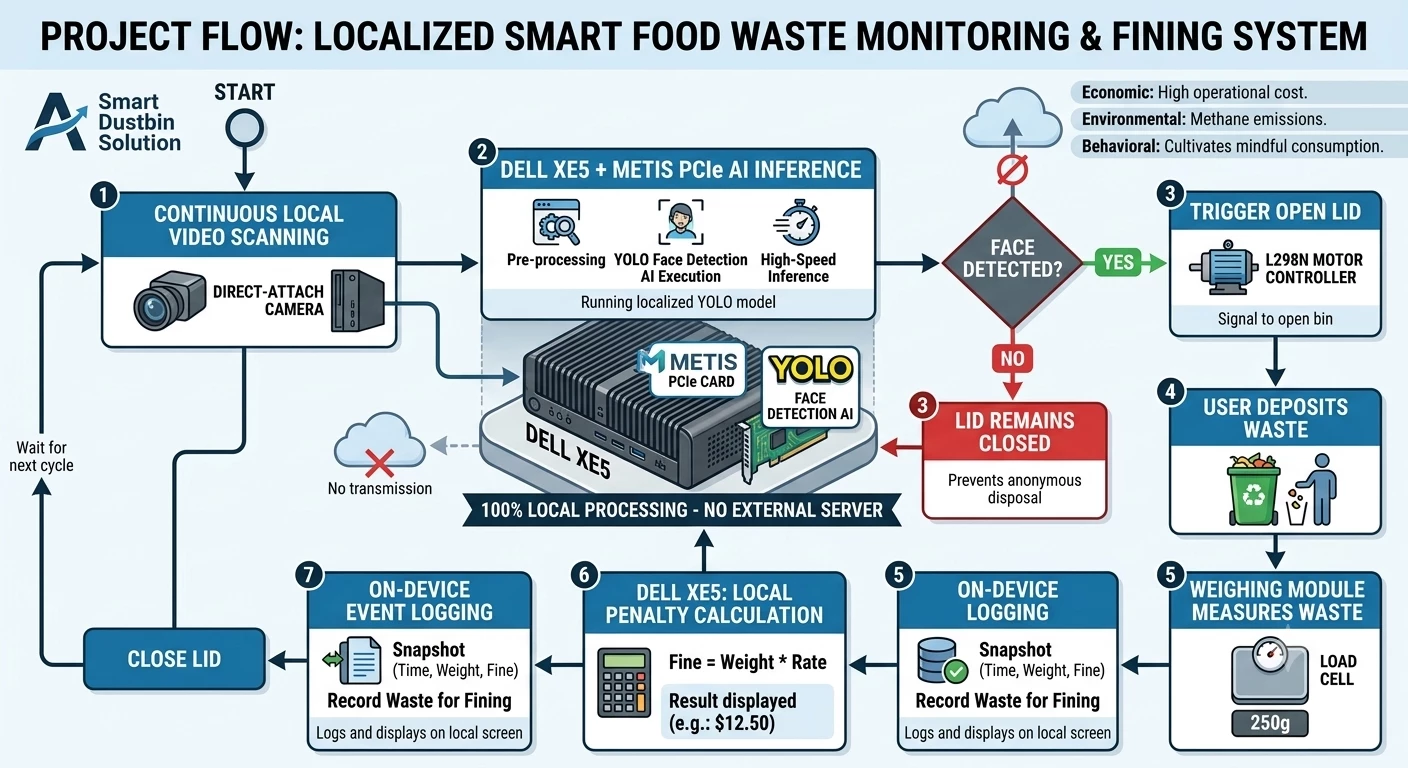
In this redesigned architecture, no video feed or biometric data is transmitted across a network or sent to a central server. The entire image capture, computer vision pipeline, hardware control, and record logging occur within a single, self-contained system powered by a Dell XE5 system equipped with a Metis PCIe card.
Detailed Operational Flow
1. Direct Local Video Capture
- The camera unit feeds high-resolution, real-time video directly into the local Dell XE5 via a direct physical bus (USB/PCIe interface) rather than streaming across a local WiFi network or sending frames to an external server.
- This setup guarantees zero transmission latency and removes network failure risks.
2. Edge AI Execution with Volvo Face Detection AI
- Local Metis PCIe Acceleration: As video frames reach the Dell XE5, the system leverages the Metis PCIe card to execute the Volvo Face Detection AI model directly in hardware-accelerated memory.
- Real-Time Detection: The Volvo Face Detection AI model evaluates incoming frames at high frame rates to determine whether a human user is physically standing in front of the smart dustbin.
- Complete On-Device Processing: Raw image frames are processed in-memory on the Dell XE5 with Metis PCIe card and immediately discarded after inference, guaranteeing complete data privacy since no images leave the machine or touch a central network.
3. Immediate Hardware Lid Control
- Face Detected (TRUE): Upon positive identification of a human presence by the Volvo Face Detection AI on the Dell XE5, the system sends a direct local actuation signal to the lid motor controller, opening the dustbin.
- No Face Detected (FALSE): If no user is detected, the lid remains securely closed, preventing anonymous waste dumping.
4. Local Weight Measurement & Penalty Logging
- Once the user disposes of their waste, the integrated load cell measures the weight.
- The Dell XE5 receives the weight reading locally, calculates the penalty based on grams wasted (e.g., $X per gram) after certain threshold weight (To avoid fining for non-edible part of the food ), and logs the event directly into its local database for institutional record-keeping.
Deep Dive: Volvo Face Detection AI on Dell XE5 & Metis PCIe
The core intelligence of this system relies on running the Volvo Face Detection AI on a dedicated edge computing setup consisting of a Dell XE5 with a Metis PCIe card:
- Optimized Hardware Acceleration: By offloading the Volvo Face Detection AI workload to the Metis PCIe card inside the Dell XE5, the system achieves real-time inference without bogging down the host CPU or requiring an external GPU server.
- Low-Latency Decision Loop: Running the Volvo Face Detection AI locally on the Dell XE5 + Metis PCIe card cuts the detection-to-lid-opening latency down to milliseconds, ensuring seamless user interaction during high-traffic dining hours.
- Privacy-First Security: Because the Volvo Face Detection AI operates entirely inside the local Dell XE5 enclosure, sensitive biometric visual data is analyzed locally and never exported to external networks or central server infrastructure.
Expected System Impact
- 20–30% Waste Reduction: The immediate behavioral feedback and local accountability deter excess food waste.
- Complete Data Privacy: Compliance with privacy standards by eliminating central server video storage or network streaming.
- Self-Contained Reliability: The system operates autonomously, unaffected by central server outages or network congestion
Prompt for Voyager Wingman
Act as a Principal Embedded AI & Computer Vision Engineer specializing in Axelera AI hardware and the Voyager SDK.
Build a complete local computer vision and control application for a "Smart Food Waste Monitoring & Automated Fining System" running on a Dell XE5 equipped with an Axelera Metis PCIe AIPU card.
### Technical & System Requirements:
1. Target Platform & Hardware Acceleration:
- Host Machine: Dell XE5.
- Acceleration Hardware: Onboard Axelera Metis PCIe AIPU card.
- Framework: Axelera Voyager SDK (InferenceStream API & YAML Pipeline builder).
- Execution Mode: 100% Local processing on-device. Strictly NO external network/Wi-Fi streaming or central server communication.
2. Computer Vision & Inference Pipeline:
- Input: Local camera feed attached directly to the Dell XE5 (e.g., /dev/video0 or USB camera).
- Model: Quantized YOLO Face Detection running on the Metis AIPU via Voyager Runtime.
- Processing: Continuous real-time detection pipeline (Pre-processing -> Metis AIPU Inference -> YOLO Post-Processing).
3. Local Control Logic & State Machine:
- Face Detection Trigger: When YOLO detects a human face with confidence >= 0.65, set state to "FACE_DETECTED" and issue a control signal over Serial/USB (e.g., /dev/ttyUSB0) to activate the motor controller (L298N/Servo) to open the dustbin lid.
- Closed Bin Logic: If no face is detected, send a signal to close/lock the lid to prevent anonymous disposal.
- Weight & Fining Calculation: Once the lid is open, read weight data (in grams) from an integrated load cell module connected over Serial/USB.
- Penalty Engine: Calculate a fine based on weight (e.g., $0.05 per gram).
- Logging & Local UI: Print real-time status and logs to a local display window/terminal (Timestamp, Face Status, Weight in grams, Calculated Fine) and record events into a local database/CSV file on the Dell XE5.
### Expected Deliverables from Voyager Wingman:
1. A valid Voyager SDK YAML Pipeline file (`food_waste_pipeline.yaml`) configuring the camera source, YOLO face detection model compiled for the Metis AIPU, and post-processing.
2. A complete Python application script using Axelera's `InferenceStream` API to parse pipeline outputs, manage the state machine, send local hardware triggers over Serial (PySerial), perform the fine calculation, and write local logs.
3. Detailed setup instructions, including model compilation steps for Metis AIPU using the Voyager SDK toolchain.
why I’m the right person to build it ?
As an Electronics and communication engineering student, I always wanted to learn and develop AI-IoT projects which helps humans to live a better life. And i have good knowledge on how Ai works and the feild of AI that i can integrate with embeded systems to make automation system .