I run digital transformation workshops for Italian SMEs, which means I spend a lot of time in meeting rooms covered in sticky notes. Process mapping sessions, mostly. And after years of trying every digital tool out there, I've accepted the truth: pen and paper wins. People think better on a whiteboard. They sketch flowcharts, build effort/impact matrices with sticky notes, draw arrows everywhere. It works.
What doesn't work is everything that comes after. Someone (usually me) photographs the wall, and then spends an evening squinting at pictures, retyping notes, trying to reconstruct a matrix that made perfect sense in the room. Regular OCR doesn't help much either, because it gives you the words but loses the structure. A matrix without rows and columns is just a word list. So in practice, half of that knowledge dies when the board gets erased.
So here's what I want to build: a small box that sits in the meeting room and captures the knowledge while it's being created.
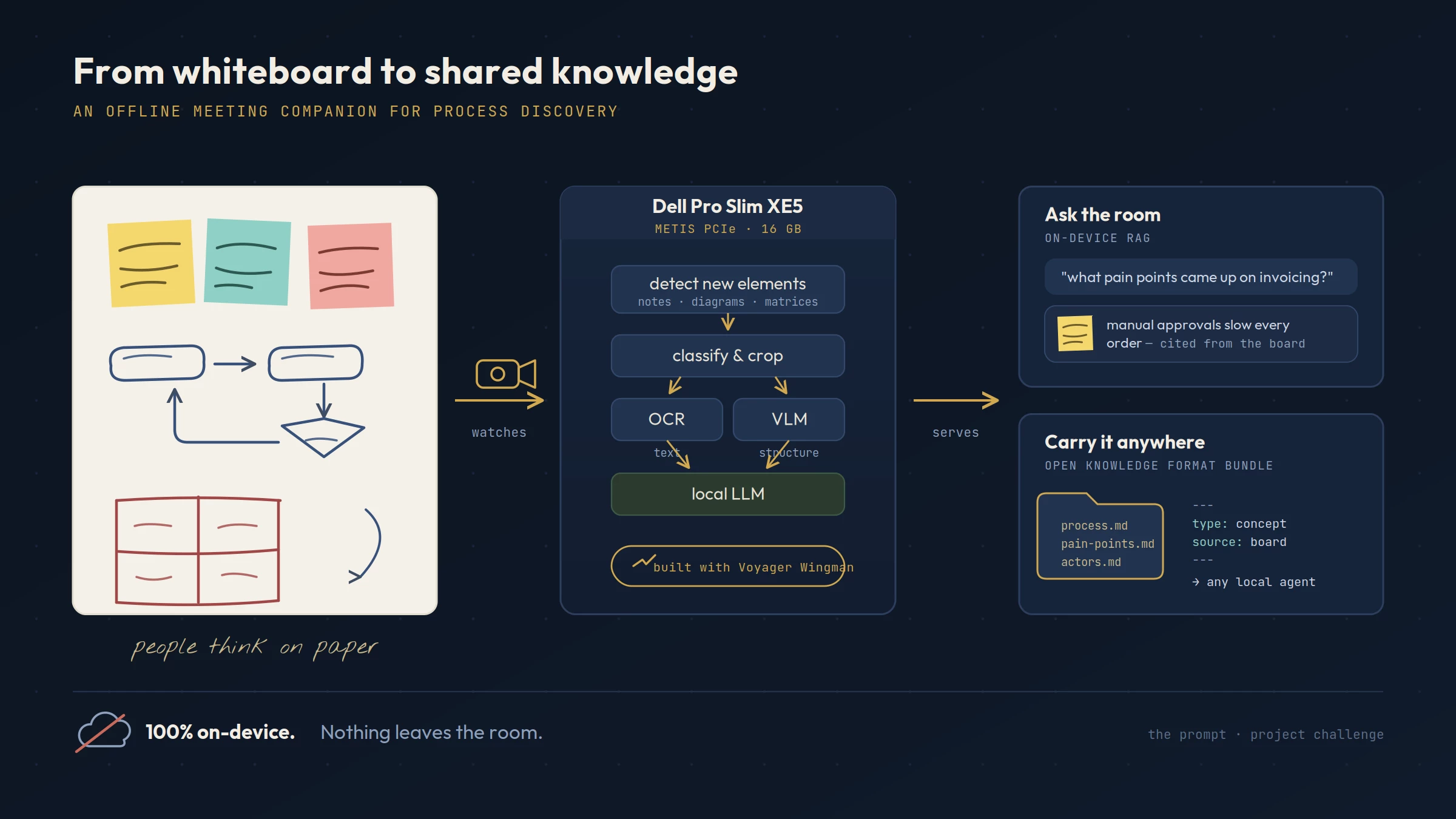
A camera points at the whiteboard. The Metis pipeline (built with Wingman) watches the board and picks up new elements as they appear, classifying each one: sticky note, text block, diagram, table. Text goes to OCR on the host. Diagrams and matrices go through a small local vision-language model instead, which extracts the actual structure, so arrows become relationships and cells keep their position. A local LLM then connects everything to the process being mapped.
At the end of the session you get two things. First, a RAG you can query right on the device: "what pain points came up around invoicing?" and it answers citing the actual notes, showing the photo crops as evidence. Second, an export of the whole session as an Open Knowledge Format bundle, the markdown+YAML spec Google published in June. That part matters to me because the goal isn't just archiving a meeting. It's making the knowledge portable: any other local agent, in the client's office or in mine, can ingest that bundle and build on it. No conversion, no platform, no cloud.
And the no-cloud part is the whole point, really. Business processes are sensitive information. I've never met an SME owner who was thrilled about uploading their order-to-cash workflow to someone's cloud just to get it digitized. A box that walks into the room, does everything locally, and walks out with the data still inside it is what makes this actually usable with real clients. That's the reason it has to be edge.
Wingman would handle the entire vision side: board monitoring, change detection, element detection and classification, crops. I'll document every prompt and every iteration, since that pipeline is exactly the part that would normally cost me weeks.
Scope for the month: capture, classification, OCR and structure extraction, RAG, OKF export, demoed live in a real workshop setup. I'm keeping diagram understanding pragmatic at first (structure and labels, not perfection) and improving from there. If time allows, two stretch goals: generating a draft process flow diagram from the captured knowledge, and reusing the same pipeline as an "idea collector" station for events.
One last thing: I teach AI adoption to SMEs for a living, so if this works it won't stay a demo. It goes into real meeting rooms in September.